📘 Introduction to SAP HANA
SAP HANA (High-Performance Analytic Appliance) is SAP’s revolutionary in-memory data platform that enables businesses to process large volumes of data in real-time. It combines database, data processing, and application platform capabilities in-memory, transforming how data is stored, processed, and analyzed.
Launched in 2010, SAP HANA has become the foundation for SAP S/4HANA, SAP’s next-generation ERP suite. It supports both OLTP (Online Transaction Processing) and OLAP (Online Analytical Processing) on a single system, offering unmatched performance and simplified IT landscapes.
🚀 Key Features of SAP HANA
- In-memory database: Stores data in RAM for faster access.
- Column-based storage: Efficient data compression and scanning.
- Parallel processing: Utilizes multi-core CPU for high-speed processing.
- Advanced analytics: Supports predictive, spatial, and text analytics.
- Real-time replication: Ensures high availability and disaster recovery.
🏗️ SAP HANA Architecture Overview

🔹 1. Database Engine
The core of SAP HANA includes:
- Row Store and Column Store
- Calculation Engine for complex computations
- SQL Processor, Script Engine, and Planning Engine
🔹 2. Persistence Layer
Ensures durability by saving data in disk even after power loss. It consists of:
- Data volumes
- Log volumes
🔹 3. Index Server
This is the main server that:
- Handles SQL/MDX queries
- Manages transactions and multi-version concurrency control
- Stores metadata and manages execution plans
🔹 4. Name Server
Maintains system topology, especially for distributed deployments.
🔹 5. Preprocessor Server
Handles text analytics by processing textual data before querying.
🔹 6. XS Engine (Extended Application Services)
Allows you to develop and run web-based applications on SAP HANA without a separate application server.
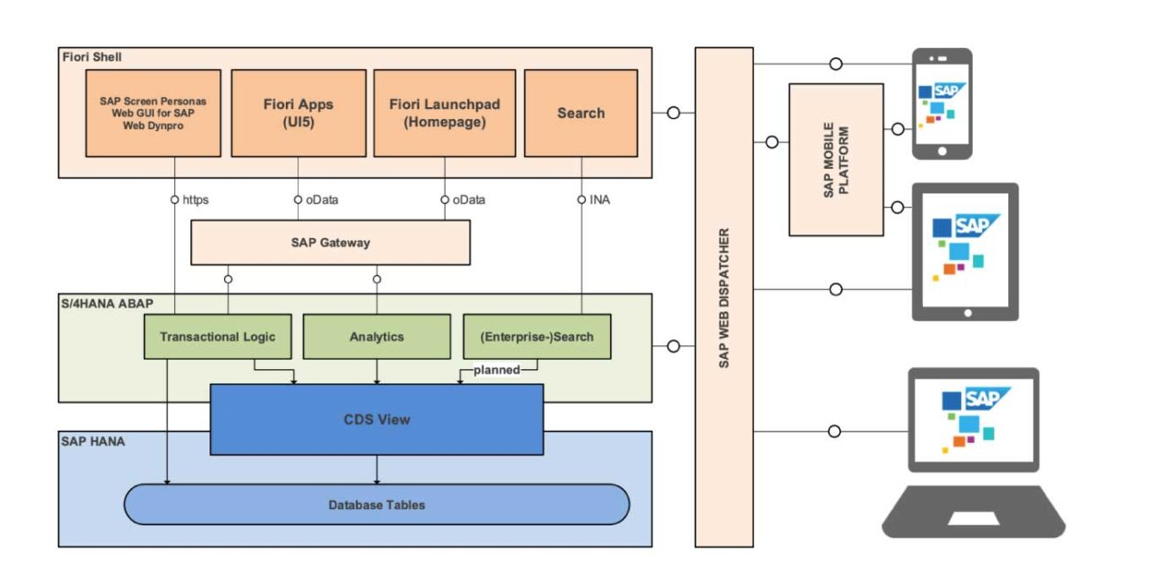
📂 SAP HANA System Components (Visual Representation)
🔸 Architecture Layered Diagram
+---------------------------------------------------+
|                  Client Interfaces                |
|    (ODBC, JDBC, HTTP/S, OData, SAP GUI, etc.)     |
+---------------------------------------------------+
|            SAP HANA XS Engine (App Layer)         |
+---------------------------------------------------+
|        Index Server – Query & Transaction Engine  |
|        - Column Store                            |
|        - Row Store                               |
+---------------------------------------------------+
|            Persistent Layer (Logs + Data)         |
+---------------------------------------------------+
|           Hardware: CPU, RAM, Disk                |
+---------------------------------------------------+
📌 Deployment Options for SAP HANA
- On-Premise: Managed internally using certified hardware.
- Cloud: Hosted on platforms like AWS, Azure, or SAP BTP.
- Hybrid: Combines on-premise and cloud for flexibility.
🛠️ Real-World Use Cases of SAP HANA
- Real-time financial reporting
- Predictive maintenance in manufacturing
- Customer behavior analytics in retail
- Fraud detection in banking
- Supply chain optimization
🔍 Related SAP Notes (Important References)
| SAP Note | Description |
|---|---|
| 1900823 | SAP HANA: Platform Lifecycle Management |
| 1994966 | SAP HANA Sizing Guidelines |
| 2393917 | SAP HANA Supported Hardware Directory |
| 2247020 | Best Practices for HANA System Copy |
👨💼 Interview Questions and Answers on SAP HANA
Q1: What is the difference between row and column store in HANA?
A: Row store stores data sequentially (good for transactional), while column store stores by columns (better for analytics and compression).
Q2: What engines are present in SAP HANA?
A: Calculation engine, SQL engine, planning engine, and script engine.
Q3: How does HANA ensure data persistence?
A: Through savepoints and logs written to the persistent layer (disk).
Q4: What is the role of the Index Server?
A: It manages database operations, query processing, and metadata.
Q5: Can SAP HANA run OLTP and OLAP together?
A: Yes, HANA’s hybrid design supports both transactional and analytical workloads.
Q6: What is XS Engine in SAP HANA?
A: It is the web server and lightweight application server in HANA.
Q7: What is delta merge in SAP HANA?
A: The process of merging the delta storage (write-optimized) into the main storage (read-optimized) for performance optimization.
Q8: How is high availability achieved in SAP HANA?
A: Through System Replication, Storage Replication, and Host Auto-Failover.
Q9: What is HANA Cockpit?
A: A web-based tool for SAP HANA administration and monitoring.
Q10: How does HANA support advanced analytics?
A: It includes built-in engines for text, spatial, graph, and predictive analytics.